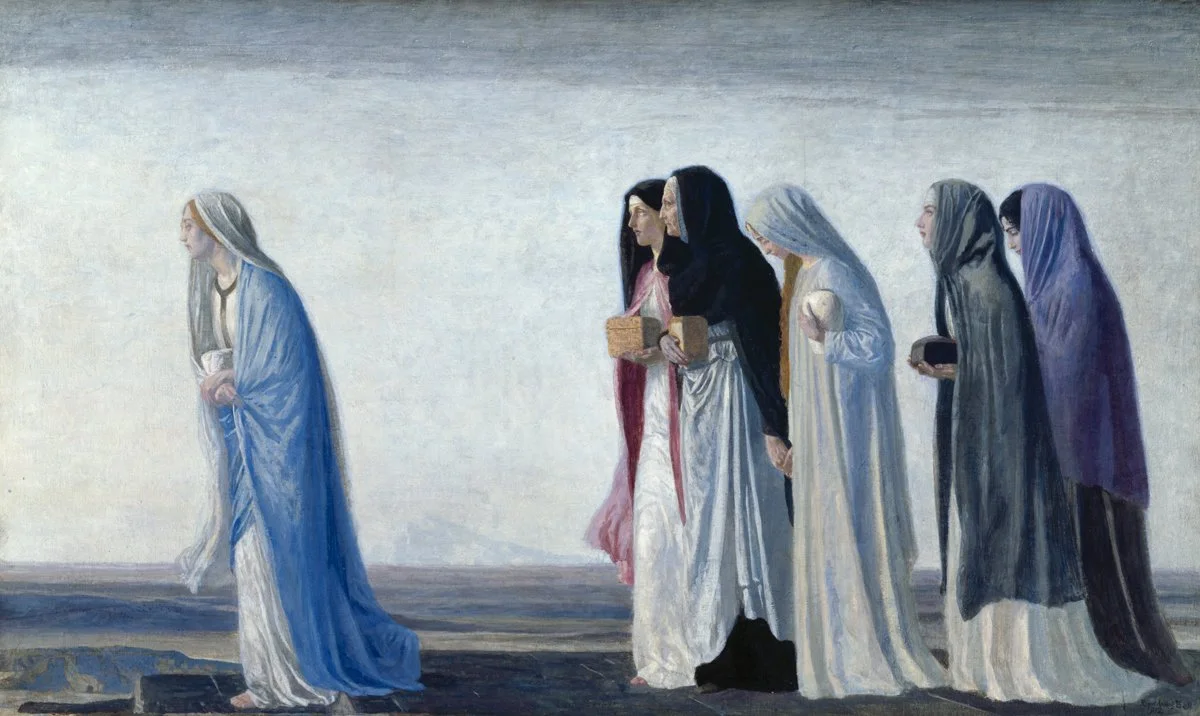
If then you have been raised with Christ, seek the things that are above, where Christ is, seated at the right hand of God. Set your minds on things that are above, not on things that are on earth. For you have died, and your life is hidden with Christ in God. When Christ who is your life appears, then you also will appear with him in glory.
— Colossians 3:1–4
“Desire” is not the first word that I typically associate with my celebration of Easter – at least, not when I feel like I am at my most devout. Yes, in many Christian traditions Easter concludes a long season of Lenten fasting prior to the biggest Sunday of the year, and so there are often delicious goodies waiting for us on the other side of Holy Week: Avgolemono Soup for some, Cadbury Cream Eggs for others. But I often slip into treating these delicacies as a worldly prize for the spiritually strong-willed who have successfully managed their forty days of purgatorial abstinence. Instead, in my own paschal devotions, I tend to dwell on the third-day reality of Jesus’s divinely human victory over death, sin, and hell. The fact of his victory, I am convinced, should be acknowledged, its significance assimilated, its truth announced far and wide to all who will listen. Something happened on the first Easter, regardless of our reaction to it, our feelings about it, or our own individual wants or desires.
But as I was praying in church with my family on Easter Sunday this year, I was struck by the way in which the traditional Collect (the concise prayer that pulls all the scripture readings together) makes “desires” a key part of the Christian message of the resurrection:
Almighty God, who through thine only begotten Son Jesus Christ hast overcome death, and opened unto us the gate of everlasting life; We humbly beseech thee, that as by thy special grace preventing us, thou doest put into our minds good desires, so by thy continual help we may bring the same to good effect, through Jesus Christ our Lord, who liveth and reigneth with thee, and the holy Ghost, ever one God world without end. Amen.
The reference here to “good desires” implanted in our minds echoes the Epistle reading for the day, Colossians 3:1–4. There, the apostle Paul not only assumes already that Christ has been raised from the dead, but he also insists that in our baptism into his death and resurrection (2:12) we too have been raised up with him. So what does he urge? “Seek the things that are above (τὰ ἄνω ζητεῖτε) where Christ is,” and, “Set your minds on things that are above (τὰ ἄνω φρονεῖτε), not on things that are on earth” (3:1–2).
Paul’s verbs in these verses are imperatives of wanting and desiring: they entail an existential need, a passionate longing, an intentional pursuit, and the hope of consummation. To “seek” and “set our minds on things above” is to remove our hearts from the treasures around us in this world (Mt 6:19–24) since they cannot sate our deeper hungers or quench our spiritual thirst. The risen Christ alone is our true life, and so he alone must become the object of our truest wants. To celebrate Easter truly, then, is to reorient our desires from earth toward the one seated at the Father’s right hand, just as it means being retrained in patience to await his coming in glory (Col 3:2, 4).
It is so difficult, however, to crave things above or things to come that cannot be seen or felt or smelt by us here and now. In fact, we have in the Gospels only the barest glimpses into Christ’s own life following his triumph over death. Even his disciples have a hard time recognizing him themselves; it takes the whisper of a name (Jn 20:16), the marks of his sufferings (20:20), the breaking of bread (Lk 24:30–31), the repetition of a miracle (Jn 21:7), or the assertion of his authority (Mt 28:18) to open the eyes of his followers so that they could see him right in front of them and remove all doubt. And if we are to set our hearts on the kingdom of God and the Lord of glory and the day of our own resurrection, don’t we need at least a foretaste of the feast to come, some present way of experiencing this eternal reality? How can we access this heavenly experience when we are not only here on earth, but are ourselves made of earth (1 Cor 15:47–49)?
Paul, however, does not seem particularly bothered by this question: after all, in the waters of baptism we have experienced these heavenly realities already: “You have been raised with Christ,” and “you have died, and your life is hidden with Christ in God” (Col 3:1, 3; emphasis added). As we hear the good news of Jesus, as we approach him through faith, as we become one with him in the Spirit, we do taste the new cosmos that was birthed on Easter morning – and it leaves us wanting more, even if initially it is only at a subconscious level. So, having “put off the old self” and “put on the new” (3:9–10), he now encourages us to “put to death what is earthly” in ourselves (3:5) and instead to “put on love, which binds everything together in perfect harmony” (3:14). And so, through the private habits and community disciplines that Paul enumerates in the verses that follow, God cultivates these affective first fruits of the resurrection within our hearts and prepares our palates for the life of the world to come by making us yearn for them. Or, to put it in the words of the Collect for Easter Day, just as his grace alone “prevents” (goes before) our genuine desire for this transfigured life, so also his help alone enables us to bring that desire to “good effect” day after day.
This Easter, I am trying to get out of my head a bit and instead pray to desire new things in new ways: to want not only those good things that can be found in this world – and they are indeed good gifts from the hand of God himself – but also the better things that the world cannot give. I am, in other words, praying to desire Jesus himself more and above everything else.